Introduction
For many households, the quest for clean, great-tasting drinking water involves a series of trade-offs. Traditional under-sink reverse osmosis systems offer powerful filtration but require plumbing modifications, dedicated cabinet space, and often a professional installation. Pitcher filters are convenient and affordable, but their filtration capabilities are limited, and they can be slow. For renters, apartment dwellers, or anyone who prefers not to alter their kitchen plumbing, these constraints can feel restrictive. The countertop reverse osmosis water filter with UV purification is designed to address these challenges, offering advanced filtration in a portable, plug-and-play format that requires no permanent installation.
Product Overview
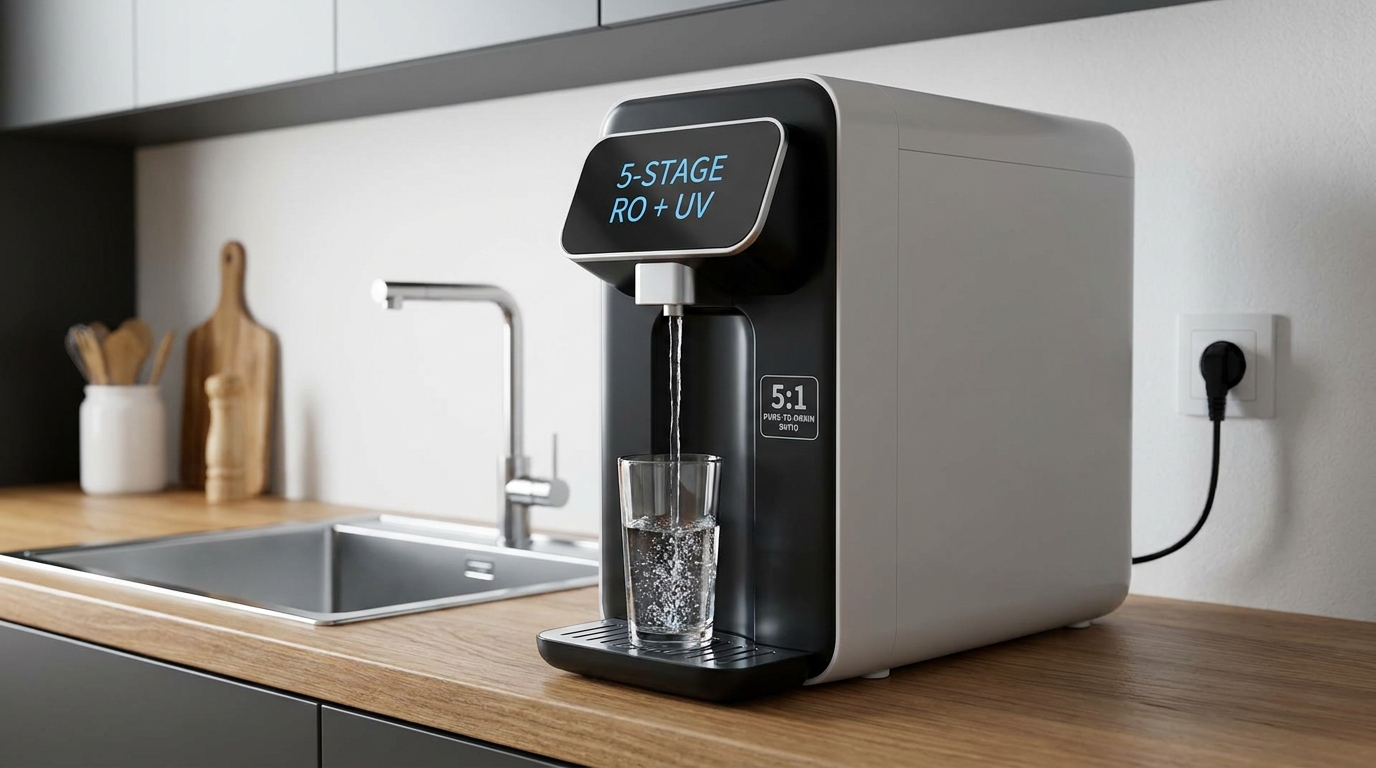
A countertop reverse osmosis water filter is a self-contained water purification system that sits on a kitchen counter, plugs into a standard electrical outlet, and dispenses filtered water on demand. It combines the deep purification capabilities of reverse osmosis with the convenience of a portable appliance. The addition of UV purification adds an extra layer of protection by using ultraviolet light to neutralize microorganisms without chemicals or by-products .
This type of system is designed for individuals and families who want the water quality of an under-sink RO system without the installation commitment. It is particularly well-suited for renters, apartment residents, office workers, RV owners, and anyone seeking a flexible hydration solution that can move with them .
Key Features
5-Stage Filtration with UV Purification
The core of these systems is a multi-stage filtration process. A typical configuration includes a PPC (Polypropylene Cotton) filter for sediment and particulate removal, followed by a reverse osmosis membrane that captures dissolved contaminants at a microscopic level . The UV purification stage uses ultraviolet light to neutralize bacteria and other microorganisms, providing an additional safety barrier without introducing chemicals . Together, these stages are designed to reduce a wide range of impurities, including heavy metals like lead and arsenic, chlorine, PFAS (often called “forever chemicals”), and total dissolved solids (TDS) .
High Water Efficiency (5:1 Pure-to-Drain Ratio)
Traditional reverse osmosis systems are known for producing significant wastewater, sometimes with ratios as high as 4:1 or worse. Modern countertop units have improved this considerably. A 5:1 pure-to-drain ratio means the system produces five cups of purified water for every one cup of wastewater, representing a substantial improvement in water conservation . For eco-conscious users, this efficiency reduces the environmental impact of water filtration .
No Installation Required
The defining advantage of countertop RO systems is their plug-and-play design. No plumbing modifications, drilling, or professional installation is needed . Users simply fill the raw water tank from the tap, plug the unit into a power outlet, and begin purifying water. This makes them ideal for rental properties where permanent modifications are not permitted .
Generous Capacity and Long-Lasting Filters
These systems typically feature a 5-liter raw water tank and a separate 2-liter purified water tank, providing convenient access to clean water throughout the day . The included filters are designed to last for up to 529 gallons, which is equivalent to roughly 6,000 standard water bottles, helping reduce plastic waste and long-term drinking water expenses .
Compact and Portable Design
Countertop units are designed with a small footprint to fit comfortably on kitchen counters, islands, or tea tables. The compact dimensions (approximately 16 inches tall and 7 inches wide) allow for flexible placement in kitchens, offices, RVs, and even camping setups . Some models feature a narrow edge design with a depth of only 26 centimeters, making them suitable for tight spaces .
Materials and Design
These systems are constructed from BPA-free, food-grade materials to ensure water safety and durability . The exterior typically features a sleek, modern aesthetic with a touchscreen or intuitive control panel for operation . Key components include the raw water reservoir, the purified water tank (often detachable for easy cleaning and pouring), and the filter housing. The design prioritizes user convenience, with features like quick-change twist filter cartridges for hassle-free maintenance .
Performance
Filtration Effectiveness
The 5-stage RO filtration process with UV is designed to deliver deep purification. The RO membrane, with a pore size of approximately 0.0001 microns, is capable of capturing particles far smaller than bacteria and most dissolved contaminants . Users have reported significant reductions in TDS levels. In one documented case, tap water with a TDS of 357 ppm and fridge-filtered water at 283 ppm were reduced to just 17 ppm by a countertop RO system . This dramatic reduction often translates to a noticeable improvement in taste, removing the metallic or chlorinated notes sometimes present in tap water .
Operational Experience
The systems are designed for ease of use. The intuitive interface allows users to select water volume options and monitor filter health . The dispensing process is generally quick, with some units capable of producing a cup of purified water in approximately 15 seconds . The purified water tank provides a ready supply, eliminating the need to wait for each individual glass. However, users should be aware that the raw water tank requires periodic refilling, and the unit itself is not lightweight (typically around 13-14 pounds), so placement is best considered semi-permanent within a room .
Common Uses
Daily Drinking Water: The primary use is providing clean, safe drinking water for households. The convenience of an on-demand supply encourages increased water consumption .
Apartments and Rentals: The no-installation design is ideal for renters who cannot modify plumbing. The unit can be moved from kitchen to office or taken along when relocating .
Offices and Small Spaces: The compact footprint makes these systems suitable for office break rooms, dorm rooms, and other spaces where a permanent water line is unavailable .
RVs and Travel: The portable nature and simple operation make countertop RO systems a practical choice for RV owners and campers who want reliable access to purified water on the road .
Coffee and Tea Preparation: The removal of chlorine and dissolved solids can improve the taste of coffee and tea, as these contaminants can interfere with flavor extraction .
Advantages
No Installation Hassle: The plug-and-play design eliminates plumbing work, drilling, and professional installation costs .
Superior Water Efficiency: The 5:1 pure-to-drain ratio significantly reduces water waste compared to traditional under-sink RO systems .
Advanced Filtration: The combination of 5-stage RO and UV purification provides comprehensive contaminant removal without the use of chemicals .
Portability and Flexibility: The compact, countertop design allows the system to be used in various locations, from home kitchens to offices and RVs .
Reduced Plastic Waste: By providing a sustainable source of purified water, these systems help reduce reliance on single-use plastic bottles .
User-Friendly Features: Touchscreen controls, filter change indicators, and self-cleaning functions simplify operation and maintenance .
Things to Consider
Counter Space Requirement: While compact, these systems still require dedicated countertop space and a nearby electrical outlet .
Manual Refilling: The raw water tank must be filled manually, which may be a consideration for larger households with high water consumption .
TDS Limitations: The performance of RO systems can be affected by high TDS levels in the source water. Most units are designed for tap or well water with TDS below 500 ppm .
Filter Replacement Costs: Replacement filters are a recurring expense. Users should factor in the cost and frequency of filter changes when evaluating the total cost of ownership .
No Hot Water: Most countertop RO systems dispense water at room temperature only. Those seeking instant hot water will need a separate appliance or a model with heating functionality .
Initial Flushing: New units require an initial flushing process to prepare the filters for use, which involves discarding several batches of water and can take some time .
Comparison with Similar Product Categories
Under-Sink Reverse Osmosis Systems: These systems are installed beneath the kitchen sink and connect directly to the home’s water supply. They offer unlimited filtered water on demand and are hidden from view. However, they require plumbing modifications, dedicated cabinet space, and professional installation. Countertop models trade the unlimited supply and concealment for portability and installation-free operation.
Gravity-Fed Pitcher Filters: Pitcher filters are inexpensive, require no electricity, and are simple to use. However, their filtration capabilities are limited (often removing far fewer contaminants than RO), and they are slow, requiring manual refilling and waiting for water to filter through. Countertop RO systems offer significantly more powerful filtration and faster dispensing, but at a higher upfront cost and with electricity dependency.
Faucet-Mounted Filters: These attach directly to the kitchen faucet and offer basic filtration. They are more convenient than pitchers but still limited in contaminant removal compared to RO. They also occupy faucet space and may not be compatible with all faucet types.
Maintenance and Care
Maintaining a countertop RO system involves periodic filter replacement and routine cleaning. Most units feature a filter change indicator that alerts the user when the filter life is depleted . Replacement typically involves a simple twist to remove the old cartridge and install a new one . The raw and purified water tanks should be cleaned periodically with mild soap and water. The exterior can be wiped down with a damp cloth. Users should follow the manufacturer’s instructions for initial setup and flushing, and replace filters according to the recommended schedule to maintain performance.
Frequently Asked Questions
What does the 5:1 pure-to-drain ratio mean?
It means the system produces 5 gallons of purified water for every 1 gallon of wastewater, making it more water-efficient than many traditional RO systems .
Does this system require any installation?
No. Countertop RO systems are plug-and-play. You simply fill the raw water tank, plug the unit into an outlet, and begin purifying water .
What contaminants does the 5-stage filtration remove?
The system is designed to remove heavy metals (like lead and arsenic), chlorine, PFAS, TDS, sediments, and other impurities. The UV stage adds protection against microorganisms .
How often do filters need to be replaced?
Filter life varies by model and usage, but typically ranges from 6 to 12 months, or up to 529 gallons of purified water. The system’s indicator light will notify you when replacement is due .
Can I use this system with well water?
It can be used with well water, but the source water should have a TDS level below 500 ppm for optimal performance. High TDS levels may reduce filter life and efficiency .
Does the system dispense hot water?
Most countertop RO systems dispense water at room temperature only. If you need hot water, look for a model that includes heating functionality or use a separate kettle .
Is the water tank detachable for cleaning?
Yes, the purified water tank is typically detachable for easy pouring and cleaning. The raw water tank is also designed to be filled manually .
Final Thoughts
The countertop reverse osmosis water filter with UV purification represents a compelling solution for households seeking high-quality drinking water without the commitment of a permanent installation. Its 5-stage filtration and UV purification provide deep contaminant removal, while the 5:1 pure-to-drain ratio addresses the water waste concerns associated with traditional RO systems. The plug-and-play design makes it accessible to renters, apartment dwellers, and anyone who values flexibility in their home appliances.
For those with limited counter space, the compact footprint of these systems is a consideration, as is the need for manual refilling and periodic filter replacement. However, for individuals and families prioritizing water quality, convenience, and sustainability, a countertop RO system with UV purification offers a practical and effective way to enjoy clean, great-tasting water every day.